
Choosing a stage
What Size Portable Stage Do You Need? Canada Planning Guide
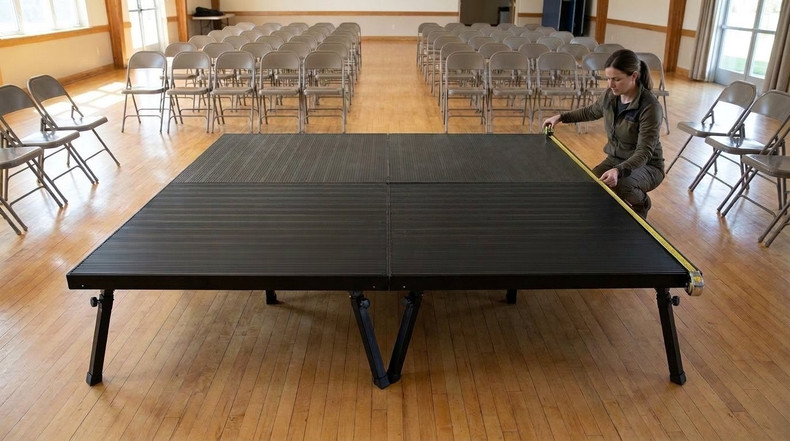
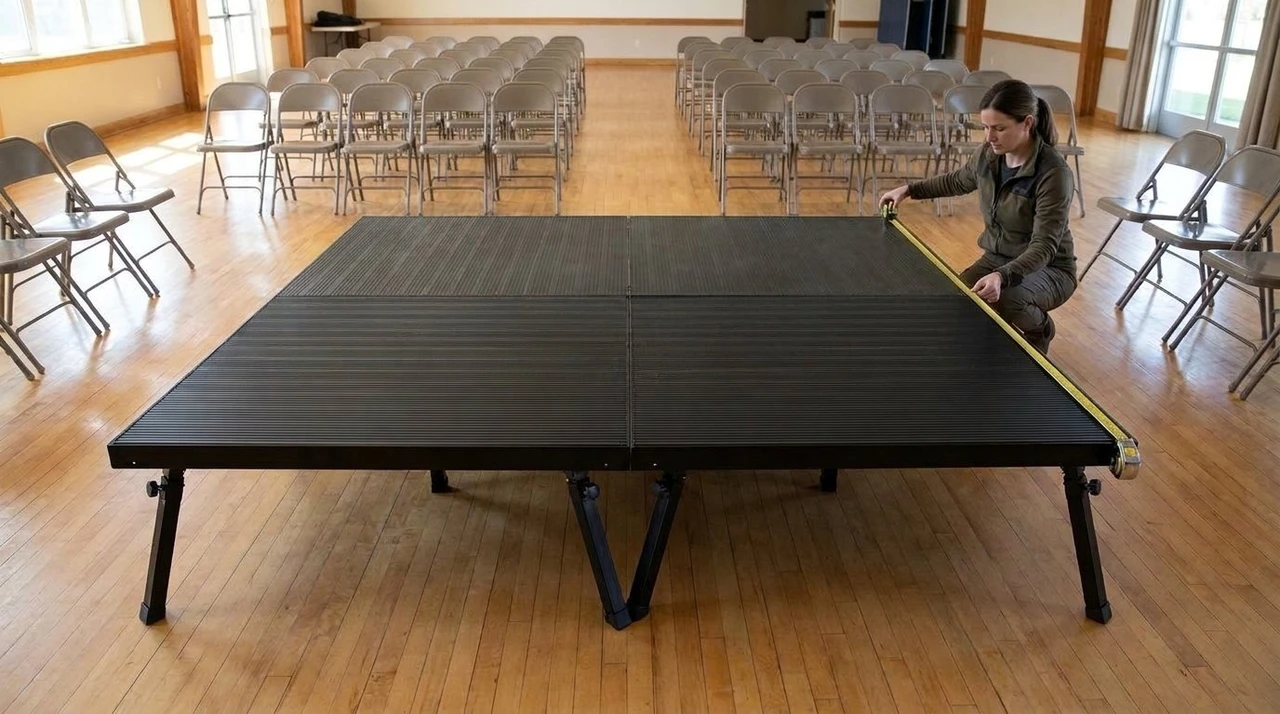
Size a portable stage from what stands on it and round up to whole decks. As a guide, one speaker fits a single 4 ft (1.22 m) deck, a panel or duo fits 4 ft x 8 ft (1.22 m x 2.44 m), and a band with drums starts at 8 ft x 16 ft (2.44 m x 4.88 m).
This portable stage size guide is for event planners and venue managers who need a number before they request a quote. The ranges below are planning assumptions, clearly labeled, not MyStage specifications. Test them against your own performers and equipment using the steps further down, then confirm the layout in the Stage Builder.
How are MyStage stage sizes measured?
MyStage stage sizes are measured in whole decks. Every stage is built from the same 4 ft x 4 ft (1.22 m x 1.22 m) aluminum deck, so each side of a stage is a multiple of 4 ft (1.22 m), and a stage cannot be 10 ft or 3 m wide.
Two terms carry through the rest of this guide:
- Stage footprint: the length and width of the finished stage surface, such as 8 ft x 12 ft (2.44 m x 3.66 m).
- Deck count: the number of decks in that footprint. Multiply the number of decks along each side: 8 ft x 12 ft is 2 decks by 3 decks, or 6 decks. Each deck adds 16 sq ft (1.49 m²) of stage.
For every standard footprint in feet and metric, see the guide to portable stage sizes and metric measurements. This page is about choosing which one you need.
What size stage do I need for my event?
Match your event to the row that describes what will be on the stage, then check the deck count and package options. Performer counts, equipment and audience settings in this table are planning assumptions for a typical layout, not limits or ratings.
| Event type | Performers (assumed) | Equipment on stage | Audience setting | Starting footprint | Decks | MyStage options (USD) |
|---|---|---|---|---|---|---|
| Speech, toast, award handoff | 1 | Lectern, microphone stand | Seated room, meeting or banquet | 4 ft x 4 ft (1.22 m x 1.22 m) | 1 | 4x4 deck US$659; with skirt US$699 |
| Panel, duo, officiant and couple | 2 to 3 | Chairs or a small table, two microphones | Seated hall, ceremony, classroom | 4 ft x 8 ft (1.22 m x 2.44 m) | 2 | 4x8 stage US$1,260; with 2 railings and 2 skirts US$1,499 |
| Acoustic act, small ensemble, presenter with screen nearby | 3 to 4 | Music stands, acoustic instruments, one small amp | Seated hall or gym | 8 ft x 8 ft (2.44 m x 2.44 m) | 4 | 8x8 stage and riser US$2,480 |
| School assembly, worship team, small dance group | 4 to 6 | Keyboard, amps, monitor speakers | Gym, sanctuary, community hall | 8 ft x 12 ft (2.44 m x 3.66 m) | 6 | 8x12 stage US$3,720; package with 4 railings and 3 skirts US$4,299; with railings, skirts and stairs US$4,499 |
| Band with drum kit | 4 to 5 | Drums, amps, keyboard, monitors | Hall or outdoor, seated or standing | 8 ft x 16 ft (2.44 m x 4.88 m) or 12 ft x 12 ft (3.66 m x 3.66 m) | 8 or 9 | 8x16 stage US$4,960; 8x16 package US$5,775; 8x16 with stairs US$5,999; 12x12 stage US$5,400 |
| Choir in rows, fashion show runway, awards line-up | Varies by row length | Little or none | Seated along the stage | 8 ft x 20 ft (2.44 m x 6.10 m) to 8 ft x 28 ft (2.44 m x 8.53 m) | 10 to 14 | 8x20 US$5,999; 8x24 US$7,080; 8x28 US$8,190 |
| Community festival or outdoor main stage | 5 or more, plus an MC | Full backline, monitors, space for changeovers | Outdoor, standing | 12 ft x 20 ft (3.66 m x 6.10 m) to 16 ft x 20 ft (4.88 m x 6.10 m) | 15 to 20 | 12x20 US$8,775; 12x20 with 7 railings and 6 skirts US$9,200; 16x20 US$11,600 |
Prices are for the products listed, in US dollars, before freight. Browse every size in the MyStage Canada portable stage range or the event stage collection.
What assumptions sit behind these ranges?
The table assumes performers need room to stand and move, not just to fit. A footprint that holds a band packed shoulder to shoulder is too small once people turn around, swap instruments, or walk to a microphone.
- Equipment takes the back of the stage. Amps, drum kits and keyboards sit behind or beside performers, so they add depth first.
- Cables and stands need floor space. Microphone stands, monitor speakers and cable runs eat into the area people walk on.
- Edges are not usable floor. Nobody should stand right at the edge of a raised stage, so treat the outer strip as a margin.
- When in doubt, add a row of decks. A stage that is one row too deep is a minor cost. A stage that is one row too shallow can push a drummer off the back or a speaker off the front.
If your event is close to the line between two rows, use the steps in the next section rather than guessing.
How do you work out the right size for your own event?
Lay out the real stage plan on the floor, then round it up to whole decks. That test takes less time than a revised order.
- List everything on the stage. Every person, instrument, amp, stand, monitor, lectern and chair, plus anything that comes on mid-event, such as a choir or an award table.
- Tape out a grid. Mark 4 ft (1.22 m) squares on the floor of a gym, parking lot or hall, one square per deck.
- Place the real items. Set out the equipment and have performers stand where they would during the event, then walk the changeovers.
- Count the squares used. Round each side up to whole squares. That is your footprint and deck count.
- Check the room. Measure where the stage will stand and leave space for stairs, exits and walkways. Confirm clearances and exit routes with the venue or your local fire officials.
- Enter it in the Stage Builder. The Stage Builder works out the decks for any footprint and shows the price.
How does the audience change the stage size?
The audience changes the stage height more than its footprint. Footprint comes from what is on the stage; height comes from how far back the last row is and whether people sit or stand.
- Low settings for small seated rooms. Shorties (US$200) have 8 in and 10 in (20 cm and 25 cm) settings, suited to a classroom, meeting room or banquet where a little lift is enough.
- Standard legs for halls and gyms. The legs included with every deck adjust from 4 to 28 in (10 cm to 71 cm).
- Taller settings for standing crowds. Biggies (US$250) go up to 36 in (91 cm), useful when a standing audience fills an outdoor site.
Height also sets what you need for access and edges. Stairs (US$299) have three steps, grip tape and a railing, for stages up to 28 in (71 cm). A step up (US$59) suits lower stages. For a stage on Biggies above 28 in (71 cm), ask MyStage about access before you order.
A wide audience can also push you toward a longer, shallower stage, such as 8 ft x 20 ft (2.44 m x 6.10 m) instead of 12 ft x 12 ft (3.66 m x 3.66 m), so people at the sides can see the performers.
How much AV equipment can a stage hold?
Each deck is rated to hold up to 3,400 lbs (1,542 kg). Size the stage for the floor area your equipment covers, and check heavy items against that rating per deck.
Plan where the AV lives before you pick a size. Main speakers on stands beside the stage, a mixing desk out in the room, and a camera on its own platform all take space off the stage. A single 4 ft x 4 ft (1.22 m x 1.22 m) deck makes a separate camera or lectern platform, and the 8 ft x 8 ft (2.44 m x 2.44 m) set is sold as a stage or riser.
Each deck stands on five legs, four angled legs plus a center leg that reduces bounce.
Should the stage be square or long and narrow?
Choose the shape from how people use the stage. Bands and worship teams work in depth, so 12 ft (3.66 m) deep layouts such as 12 ft x 12 ft or 12 ft x 20 ft give a back line for drums and amps. Choirs, award line-ups and runways work in length, so 8 ft (2.44 m) deep layouts such as 8 ft x 24 ft (2.44 m x 7.32 m) put everyone close to the front.
Because every stage is built from the same deck, the same decks can form a square one weekend and a long runway the next. Decks connect to each other with wingnuts, and one person sets up a deck in about a minute with no tools.
Can you start smaller and add decks later?
Yes. Every MyStage deck is the same size and connects to the others, so a 4 ft x 8 ft (1.22 m x 2.44 m) stage can grow to 8 ft x 8 ft or 8 ft x 16 ft by adding decks. Railings and skirting are added the same way.
If you only need a large stage once or twice a year, compare the options in portable stage rental vs purchase in Canada.
What else should Canadian buyers know when picking a size?
Size drives the freight quote, so settle it before you ask for shipping. Canadian orders ship from our warehouse in Ajax, Ontario, to everywhere in Canada except Quebec, and MyStage does not ship to Quebec.
Prices are in US dollars, and your card issuer converts the charge to Canadian dollars at its own rate. Freight is quoted per order: send MyStage your products and postal code and you get an estimate before ordering. The full process is in how to buy a portable stage in Canada.
Frequently asked questions
How many decks are in an 8 ft x 16 ft stage?
Eight. An 8 ft x 16 ft (2.44 m x 4.88 m) stage is 2 decks by 4 decks, and each deck is 4 ft x 4 ft (1.22 m x 1.22 m).
What size stage does a band need?
As a planning starting point, a band with a drum kit starts around 8 ft x 16 ft (2.44 m x 4.88 m) or 12 ft x 12 ft (3.66 m x 3.66 m). Tape out the layout with the real equipment to confirm, and add a row of decks if it is tight.
How high should a portable stage be?
It depends on the audience. Shorties give 8 in or 10 in (20 cm or 25 cm) for small seated rooms, standard legs adjust from 4 to 28 in (10 cm to 71 cm), and Biggies go up to 36 in (91 cm) for standing crowds.
How much does a 12 ft x 20 ft stage weigh?
A 12 ft x 20 ft (3.66 m x 6.10 m) stage uses 15 decks at 42 lbs (19 kg) each, or 630 lbs (286 kg) of decks. Accessories add to that.
Is there a stage deck calculator?
Yes. The Stage Builder works out the decks for any footprint and shows the price, and the metric sizes guide lists the deck count for each standard size.
Send MyStage your layout, the height you need and your postal code, and get a quote before you order.