
Choosing a stage
Modular Stage vs Folding Stage: Which System Fits Your Venue?
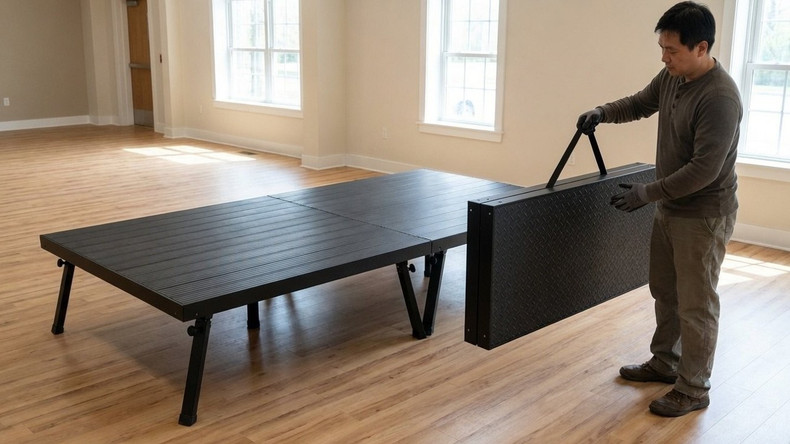
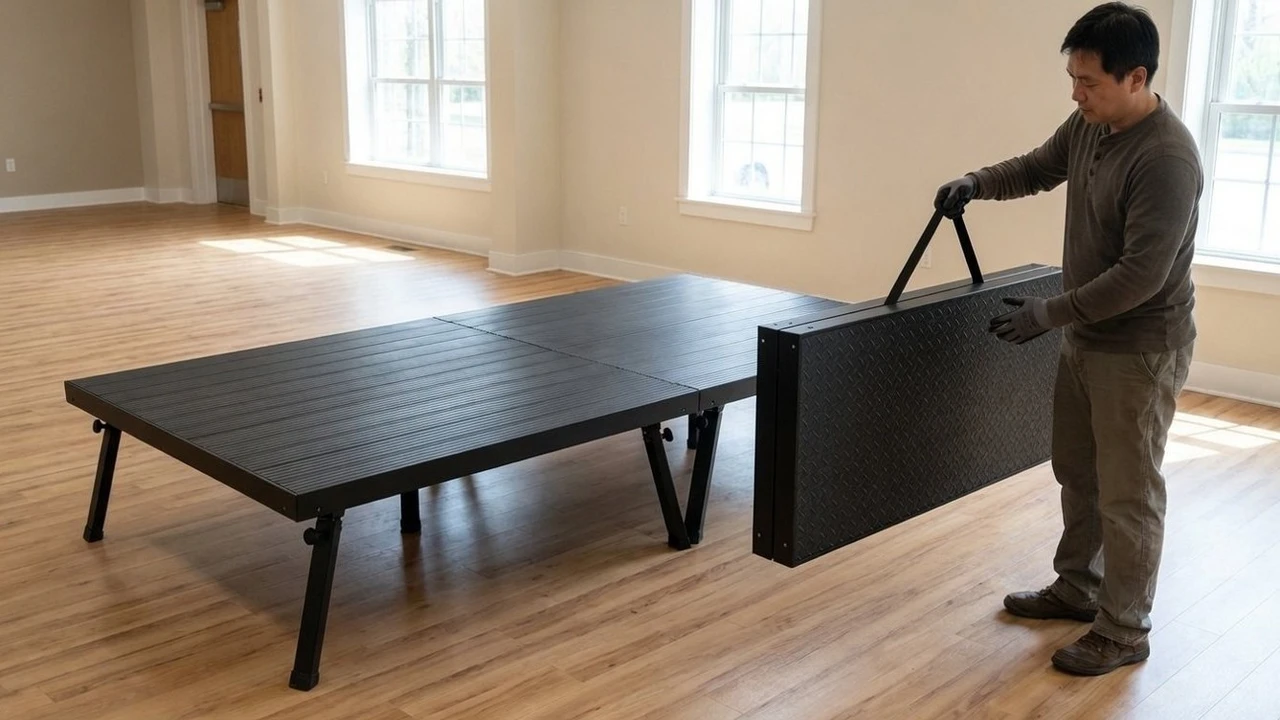
Choose a modular stage if your venue needs different stage shapes, sizes and heights for different events. Choose a one-piece folding stage if the room always uses the same platform in the same spot. MyStage combines both: separate 4 ft x 4 ft (1.22 m x 1.22 m) decks that each fold in half for carrying and storage.
This guide is for venue and facilities managers in Canada. Where a point is general planning practice rather than a MyStage specification, it is labeled that way.
What is the difference between a modular stage and a folding stage?
A modular stage is built from separate, identical platforms that connect to form whatever footprint you need. A folding stage is a platform that folds to a smaller size for moving and storage. One term describes assembly and the other describes storage, so a single product can be both.
- Modular stage: a system of individual decks joined together. You add or remove decks to change size and shape.
- Folding stage (one-piece unit): a platform, often on its own frame or wheels, that opens to a set size and folds closed as a unit. The size is fixed by the product.
- Folding deck (modular): each individual deck folds for carrying, and the decks still connect into larger layouts. MyStage decks are this type.
Treat "folding stage" as a description to question, not a category. When a supplier uses the term, ask whether the whole stage folds as one piece or whether each section folds on its own, because that answer decides how flexible the stage is and how it moves through your building.
How does a MyStage system fit these definitions?
MyStage is a modular system made of folding decks. Every MyStage stage uses the same 4 ft x 4 ft (1.22 m x 1.22 m) aluminum deck with a black diamond-plate surface, and decks connect to each other with wingnuts.
Each deck folds in half to 2 ft x 4 ft (0.61 m x 1.22 m), has a shoulder strap, and weighs 42 lbs (19 kg), so one person carries it. Each deck has five legs (four angled legs plus a center leg that reduces bounce), and one person sets up a deck in about a minute with no tools. Each deck is rated to hold up to 3,400 lbs (1,542 kg).
Modular vs folding stage decision table
Use this table to score the two formats against how your venue actually runs events. The one-piece folding column describes the format in general terms, because products vary; confirm the details with any supplier you are considering.
| Factor | Modular stage (MyStage folding decks) | One-piece folding stage (general format) | Question for your venue |
|---|---|---|---|
| Layout flexibility | Any footprint in 4 ft (1.22 m) steps: 4x4, 4x8, 8x8, 8x12, 8x16, 8x20, 12x20, 16x20 and more. | Fixed size and shape per unit. Larger stages usually mean joining several units, if the product allows it. | Do your events use the same stage every time, or does the shape change? |
| Setup | One person sets up a deck in about a minute, with no tools. Larger stages take longer because there are more decks to place and connect. | Depends on the product. Ask how many people it takes and whether tools are needed. | Who sets up the stage, and how much time is there between events? |
| Storage route | Each deck folds to 2 ft x 4 ft (0.61 m x 1.22 m) and weighs 42 lbs (19 kg), so it moves by hand through standard routes. Castors (set of 5) and a gear bag are available. | The unit moves as one larger piece, often on its own wheels. Doors, corners and storage doors must fit the folded unit. | What is the narrowest door, tightest corner and smallest storage space on the route? |
| Crew | One person carries one deck. A bigger crew speeds up large layouts but is not required for each deck. | Ask the supplier how many people are needed to fold, roll and unfold a unit safely. | How many trained staff are on site on a typical event day? |
| Accessories | Railings in 4 ft (1.22 m) sections, stairs, a single step up, skirting in black or white, castors and a gear bag, all fitting the same deck. | Ask which railings, stairs and skirting fit the unit and whether they fit every height. | Which events need railings, stairs or skirting? |
| Repeat use | The same decks rebuild into a new layout for each event, and you can add decks later. | Repeat use is simple when every event needs the same platform. | How often will the stage be set up, and will needs change over the coming years? |
When does a modular stage fit a venue better?
A modular stage fits better when the venue hosts different kinds of events in the same space. A banquet hall that runs a head table one weekend and a band the next, or a gym that hosts an assembly and a concert, benefits from changing the footprint instead of owning several fixed platforms.
Modular decks also suit venues where the stage moves between rooms or buildings. Because the heaviest piece is a single 42 lb (19 kg) folded deck, the stage can be carried through standard routes in pieces rather than rolled as one large unit. For venues that also stage outdoors, the legs adjust to level each deck on uneven ground.
Growth is the third reason. A school or community center can start with an 8x8 (four decks) and add decks later to reach an 8x12 or 8x16, as long as the new decks are the same system. For a deck-by-deck sizing method, see portable stage sizes and metric measurements.
When does a one-piece folding stage make sense?
A one-piece folding stage can make sense when the venue always uses the same platform, in the same place, at the same height. If nothing about the stage changes between events, the flexibility of a modular system matters less.
Check the storage route before you decide. A unit that folds as one piece still has to fit through every door and corner between storage and the room, and it needs a storage space that holds its folded size. Measure that route with the supplier's folded dimensions in hand.
How do you compare stage systems, step by step?
- List your events. Write down every event type in a typical year and the stage size, shape and height each one needs.
- Measure the storage route. Record the narrowest door, the tightest corner, any stairs, and the storage room's floor space and door.
- Count your crew. Note how many people normally set up and strike, and how much time they have.
- Price the layouts. Use the Stage Builder to work out the decks and price for each footprint on your list.
- Add accessories per event. Mark which events need railings, stairs, a step up or skirting.
- Ask each supplier the same questions. Use the table above so the answers line up side by side.
What does a modular MyStage setup cost?
MyStage prices are listed in US dollars (USD). A single 4'x4' Portable Stage Deck is US$659, a 4'x8' stage (2 decks) is US$1,260, an 8'x8' stage (4 decks) is US$2,480, and an 8'x12' stage (6 decks) is US$3,720.
Package options bundle accessories. The 8'x12' package with 6 decks, 4 railings and 3 skirts is US$4,299, and the 8'x16' package with 8 decks, railings and skirting is US$5,775. Accessories sold separately include railings at US$99 per 4 ft section, stairs at US$299, a step up at US$59, skirting at US$58, castors at US$300 for a set of 5, and a gear bag at US$88.
Your card issuer converts the USD charge to Canadian dollars at its own rate and may add a foreign transaction fee. Confirm any applicable taxes on your quote.
How does buying a modular stage work in Canada?
Canadian orders ship from our warehouse in Ajax, Ontario, to everywhere in Canada except Quebec. Because the stage ships from inside Canada, there are no customs or brokerage steps for you as the buyer.
Freight is quoted per order and checkout does not calculate it automatically. Contact MyStage with your products and postal code to get a shipping estimate before you order, and use the quote to ask about delivery timing and receiving at your building. Confirm remote and northern addresses when you request your quote. The full process is in how to buy a portable stage in Canada, and you can browse layouts in the portable stage collection.
Frequently asked questions
Is MyStage a modular stage or a folding stage?
MyStage is both. It is a modular system of 4 ft x 4 ft (1.22 m x 1.22 m) decks that connect with wingnuts, and each deck folds in half to 2 ft x 4 ft (0.61 m x 1.22 m) for carrying and storage.
Can one person set up a modular stage?
One person sets up a MyStage deck in about a minute with no tools, and one person carries a folded deck by its shoulder strap. Larger stages take longer simply because there are more decks to place and connect.
Can I add decks to a modular stage later?
Yes. Every MyStage stage uses the same deck, so you can start with a smaller layout and add decks later to make a larger one. Use the Stage Builder to see the deck count and price for the new size.
How do I store a modular stage?
Fold each deck to 2 ft x 4 ft (0.61 m x 1.22 m) and store the decks together. A gear bag holds one folded deck, and castors (set of 5) with brakes are available for moving decks.
What should I ask before buying a folding stage?
Ask whether the whole stage folds as one unit or each section folds separately, its folded size and weight, how many people it takes to set up, which accessories fit, and how heights adjust. For a MyStage order in Canada, also request a freight estimate with your postal code.