
Setup and leveling
How to Set Up a Stage for an Outdoor Concert: The Complete Planning Guide
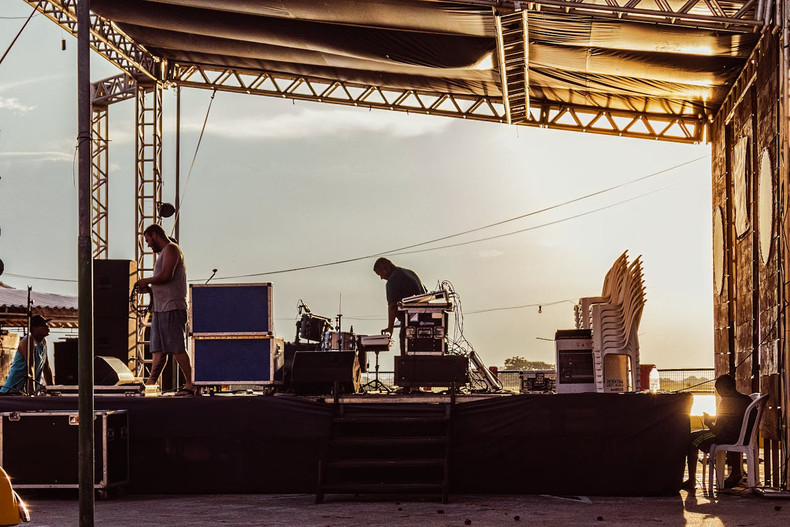
A complete outdoor concert stage setup requires a modular platform system rated for uneven terrain, a drum riser, PA system sized for open-air projection, stage lighting, power supply, and a weather contingency plan. Setup sequence matters: site assessment and permits come first, then platform build, then backline, then sound and lighting. The entire process can take two hours for a small event or two days for a festival-scale production.
Outdoor concerts operate in one of the most demanding environments in live production. Unlike indoor venues — where the room itself contains sound, reflects light, and provides a stable, level surface — an outdoor performance site gives you nothing for free. The ground may slope. The sky may open. The sound you carefully calibrated at soundcheck will behave differently when the audience fills the space and ambient temperature drops after sunset.
The current landscape of outdoor event production demands a systematic approach to stage setup that accounts for every variable before the first performer arrives. Productions that fail to plan for outdoor-specific challenges — unstable ground, wind loads on elevated platforms, open-air PA sizing, power supply logistics, and permit compliance — create safety risks and technical failures that no amount of in-show troubleshooting can fix.
This guide covers the complete outdoor concert stage setup process: what equipment you need, how to size your stage for the event, what separates an outdoor setup from its indoor equivalent, and the step-by-step process for building a production-ready outdoor stage from the ground up.
What Is Included in an Outdoor Concert Stage Setup?
A complete outdoor concert stage setup includes the main platform, drum riser, PA system, monitor system, stage lighting, power supply, backline, and safety barriers. Outdoor-specific additions include weather protection for electronics, platform systems rated for uneven terrain, generator power, and noise ordinance compliance measures not required for indoor productions.
Understanding the full scope of an outdoor concert stage setup is the first planning task. Productions that underestimate scope arrive short on platforms, short on power, or short on time. The complete equipment list for an outdoor concert stage divides into four categories:
Stage Structure
- Main stage platform — modular decks sized to the performance configuration
- Drum riser — elevated platform at the rear of the stage for the drum kit
- Keyboard or percussion risers as required by the performance lineup
Camera risers for video crew positions — especially important for outdoor events where portable camera riser platforms allow elevated shooting positions anywhere on or around the stage.
- Stage skirting — perimeter finish that conceals the understructure and defines the professional boundary of the stage
- Access steps or ramps for performer load-in and emergency egress
Sound System
- PA speaker stacks or line array system — sized significantly larger than an equivalent indoor show due to open-air sound dissipation
- Subwoofers — positioned and configured for directional control in open air
- Stage monitor wedges or in-ear monitor (IEM) system
- Front-of-house mixing console and monitor console
- Microphones, stands, DI boxes, and all signal chain components
- Cables, snakes, and tie lines — protected with cable ramps in audience areas
Lighting
- Stage wash and key lighting — factoring in ambient daylight for daytime shows
- Backlight and beam effects for evening and night shows
- Hazers or atmospheric effects if weather and wind conditions permit
- Lighting console and power distribution for dimmer systems
Power and Infrastructure
- Generator or temporary power supply — sized for total load including PA, lighting, and backline
- Power distribution units and feeder cable runs
- Safety barriers and crowd control fencing
- Weather protection — covers for mixing console, PA components, and power supply
Outdoor Concert Stage vs. Indoor Stage: What Actually Changes
Outdoor concert stage setup differs from indoor staging in four critical ways: ground surface variability requires self-leveling platform systems, open air requires larger PA systems, weather exposure demands contingency planning for every piece of electronic equipment, and permit requirements add pre-event administrative complexity that indoor venue productions do not face.
The comparison between outdoor and indoor staging is not merely aesthetic — it is structural, acoustic, electrical, and logistical. Every decision made for an indoor show must be re-evaluated for outdoor deployment:
|
Factor |
Outdoor Concert Stage |
Indoor Stage |
|---|---|---|
|
Ground Surface |
Variable — grass, concrete, gravel, asphalt, packed earth |
Level, fixed floor — usually concrete or wood |
|
Weather Exposure |
Wind, rain, UV, temperature variation — all active threats |
Controlled environment — no weather variables |
|
Sound Projection |
Sound dissipates in open air — PA must be sized accordingly |
Room boundaries reflect and contain sound |
|
Platform Stability |
Legs must self-level on uneven terrain — 5-point systems required |
Standard legs adequate on flat floor surface |
|
Setup Time |
Fast breakdown essential — weather windows unpredictable |
More forgiving — can stage equipment in advance |
|
Power Supply |
Generator or temporary power run required in most venues |
Permanent mains supply typically available |
|
Permit Requirements |
Noise ordinances, temporary structure permits, site permissions often required |
Venue handles compliance — typically no performer action needed |
|
Audience Sightlines |
No walls or ceiling — wider viewing angles, more elevation needed |
Contained viewing area — sightlines predictable |
|
? Expert Insight: The Ground Problem Nobody Talks About The single most underestimated challenge in outdoor concert stage setup is ground surface variability. A stage platform that sits perfectly level on a concrete floor will reveal every slope and soft spot on a grass field. Productions that use fixed-leg platforms on outdoor sites end up shimming legs with whatever is available — a practice that creates instability and safety risk. The correct solution is a platform system with a 5-point leg geometry that distributes weight across more contact points and self-compensates for modest terrain variation. For significant slopes, adjustable legs that dial in to the exact terrain profile are the professional standard. |
How to Size Your Outdoor Concert Stage
Outdoor concert stage size is determined by three variables: the number of performers and their equipment footprint, the audience size and required sightline distances, and the available site footprint. A private event for under 50 people needs 8x12 feet minimum. A small festival with 500 attendees requires 16x24 feet. Events over 1,000 people need 24x32 feet and above with dedicated performer sub-stages.
Stage sizing is the most consequential decision in outdoor concert stage planning — and the one most often made too conservatively. An undersized stage creates a cascade of problems: performers are crowded, backline equipment hangs off the edge, monitors are poorly positioned, and emergency egress becomes difficult. The correct approach is to size up from the minimum functional footprint by at least one deck section in each direction.
|
Event Scale |
Audience Size |
Recommended Stage Size |
Key Considerations |
|---|---|---|---|
|
Backyard / Private |
Under 50 |
8'x8' to 8'x12' |
Portability priority — fast setup and breakdown |
|
Community Event |
50–250 |
12'x16' to 16'x20' |
Add drum riser + skirting for professional finish |
|
Festival Stage (small) |
250–1,000 |
16'x24' to 20'x28' |
Dedicated drum riser; camera riser for video crew |
|
Festival Stage (large) |
1,000–5,000 |
24'x32' and above |
Multiple modular decks; dedicated sub-stages per performer |
|
Corporate / Event |
100–500 |
12'x16' to 16'x20' |
Skirting essential for brand aesthetics; podium platform needed |
The modular portable stage platform system used in our event configurations builds any of the sizes above from the same 4'x4' deck — eliminating the need to purchase different platforms for different event scales. Event stage configurations are available pre-configured for common outdoor production footprints.
How to Set Up an Outdoor Concert Stage: Step-by-Step
A professional outdoor concert stage setup follows a defined sequence: site assessment first, permits confirmed, platform built and leveled, sub-stages and risers installed, power run and tested, backline positioned, sound and lighting rigged, safety inspection conducted, and soundcheck completed. Skipping or reordering steps in this sequence creates compounding problems that are significantly harder to fix under show pressure.
The sequence below applies to events from community concerts to small festival productions. Scale the time and crew requirements up for larger configurations, but the order of operations is consistent:
- Site Assessment (Day Before or Morning of Event): Walk the entire performance area before any equipment arrives. Identify ground surface type, slope, drainage, power access points, audience flow paths, and any obstructions. Photograph the site and mark the stage footprint with stakes or chalk. Confirm sight lines from the rear of the audience area to verify stage height requirements.
- Permit and Permission Confirmation: Verify noise ordinance compliance times, temporary structure permit status, and site owner permissions. This step must be completed before the event date — ideally weeks in advance. Do not begin setup on a site where permit status is unresolved.
- Platform Assembly: Build the main stage platform on the prepared surface. Use a modular system with tool-free connections for fastest assembly. Start from the center deck and work outward to maintain level reference. Lock all deck connections and test leg stability before loading any weight onto the structure.
- Sub-Stage and Riser Installation: Position the drum riser at the rear of the main stage. Add keyboard, percussion, or DJ risers as required. Install camera risers at designated video crew positions. Confirm all sub-stages are level, locked, and connected where required to the main platform.
- Power Supply Setup: Run generator or temporary power feeds to the stage before any electronic equipment is positioned. Test all circuits under load before connecting PA or lighting systems. Route all cables in pedestrian areas through protective cable ramps.
- Backline and Monitor Positioning: Position backline amplifiers and stage monitors before running signal cable. Confirm monitor wedge positions match the monitor engineer's plan for each performer's zone. Run all stage cable cleanly — taped and labeled at both ends.
- PA and Lighting Rig: Position PA stacks or raise line array elements to their flying or ground-stacked positions. Set up stage lighting on stands or truss. Factor in ambient daylight levels for any daytime show elements — outdoor daylight overpowers most conventional stage wash at close range.
- Safety Inspection: Walk the entire stage structure with the production manager before the first performer loads in. Check all platform connections, leg locks, power cable routing, edge conditions, and emergency egress paths. This is the last opportunity to identify and correct structural issues before the show.
|
? Expert Insight: The Soundcheck Outdoor Adjustment Most Productions Miss Outdoor soundchecks consistently reveal one surprise: the mix that sounded balanced with an empty site changes significantly when the audience fills the space. Human bodies absorb high frequencies at a rate that can noticeably dull the top end of a mix — often 2-4 dB of attenuation above 4kHz in a fully packed outdoor audience. Experienced front-of-house engineers compensate by setting the empty-site mix slightly brighter than feels comfortable, knowing the audience will pull it back to target. First-time outdoor productions that don't account for this typically spend the first song of the show correcting a mix that suddenly sounds dull. |
Weather Considerations for Outdoor Concert Stage Setup
Weather is the variable that outdoor concert stage planning cannot ignore. Wind loading on elevated platforms, rain exposure for electronics, temperature effects on cable and connector integrity, and lightning risk all require active mitigation strategies. A professional outdoor stage setup includes a written weather contingency plan that specifies clear triggers for show delays, performer holds, and full stage evacuation.
Wind
Wind is the primary structural threat to an outdoor stage platform. Light stands, monitor wedges, and microphone stands are all susceptible to wind uplift and lateral forces at wind speeds that most audiences would consider merely breezy. Platform stability is the foundation — a 5-point leg system distributes the structure's footprint to resist lateral movement. Above 25 mph sustained wind, most production protocols call for securing or removing all tall-standing elements and evaluating show continuation.
Rain
Rain protection for outdoor productions centers on electronics — the mixing console, power distribution equipment, wireless receivers, and any DSP processing that lives backstage. Tent coverage over the front-of-house position and stage wings, weatherproof enclosures for power distribution, and IP-rated loudspeaker systems where budget allows are the standard mitigation measures. All cable connections should be protected from water pooling with cable bridges or elevated cable routes.
Lightning
Lightning is the only weather condition that requires an immediate and non-negotiable stage evacuation. Most professional outdoor event protocols specify clearance when lightning is within a defined radius — commonly 8 miles — and a mandatory hold period of 30 minutes after the last lightning detection within that radius. A dedicated weather monitoring service for the event date is standard practice for any production with a significant audience.
Temperature and Direct Sunlight
Electronic equipment generates heat — and direct afternoon sun significantly accelerates thermal loading on amplifiers, processing equipment, and wireless systems. Position equipment racks in shaded areas wherever possible. Allow adequate airflow around all rack-mounted equipment. Wireless systems operating in high-ambient-temperature conditions may require derating from their published channel counts to maintain signal reliability.
Outdoor Concert Stage Setup for Specific Event Types
Music Festivals
Festival stage setup at scale requires multiple modular platform configurations running simultaneously across multiple stages — often with tight changeover windows between acts. The primary operational advantage of a modular system is the ability to pre-build the next act's configuration on a parallel platform while the current act performs. Portable stage platforms that share the same deck and leg system across all configurations dramatically reduce the equipment inventory required to run multiple stages.
Community and Civic Events
Community events — park concerts, civic ceremonies, school outdoor performances — typically need a stage that deploys and breaks down on a tight schedule and leaves no permanent footprint. Portable modular platforms that assemble without tools and fold flat for transport are the preferred solution for this context. The graduation stage configuration addresses related outdoor ceremony staging requirements.
Corporate and Brand Events
Corporate outdoor events prioritize aesthetic finish and brand alignment alongside functional staging. Skirted stage platforms with consistent color and material choices, integrated podium positions, and camera-ready lighting setups are the standard specification. These productions typically have more rigorous permitting requirements and stricter venue restoration expectations than arts productions.
Church and Worship Outdoor Events
Outdoor church services and worship events require staging that scales to the specific congregation size and site, deploys and breaks down by the volunteer crew available, and presents a professional aesthetic consistent with the ministry's brand. Church stage platform configurations are available pre-sized for common worship outdoor setups, including drum riser and skirting options.
Frequently Asked Questions: Outdoor Concert Stage Setup
Q1. What is included in an outdoor concert stage setup?
A complete outdoor concert stage setup includes the main platform, drum riser, PA system, monitor system, stage lighting, power supply, backline, and safety barriers. Outdoor-specific additions include weather protection for electronics, platform systems rated for uneven terrain, generator power, camera risers for video crew, and noise ordinance compliance measures not required for indoor productions.
Q2. How is an outdoor concert stage different from an indoor stage?
Outdoor stages must contend with variable ground surfaces, weather exposure, open-air sound dissipation, and the absence of reflective walls that indoor venues provide. They require platform systems that self-level on uneven terrain, PA systems significantly larger than equivalent indoor shows, and weather contingency planning that indoor events do not need.
Q3. What equipment is needed for an outdoor concert stage?
Essential equipment includes a modular stage platform, drum riser, PA system sized for outdoor projection, monitor system, stage lighting, power supply, microphones and DI boxes, a front-of-house mixing console, and safety barriers. Camera risers, weather protection covers, and cable ramps for pedestrian areas are outdoor-specific additions.
Q4. How do I choose the right location for an outdoor concert stage?
Choose a location with level or gently sloping ground, clear audience sightlines from the widest possible angle, proximity to power supply, adequate drainage to avoid water pooling under the stage, and sufficient clearance from trees or structures that could affect PA projection or create safety hazards in high winds.
Q5. What permits are needed for an outdoor concert stage?
Permit requirements vary by jurisdiction but commonly include a temporary structure permit for the stage platform, a noise ordinance variance or special event permit, and site permission from the property owner or local authority. Most jurisdictions require permit applications 30 or more days before the event date.
Q6. What are the safety measures for an outdoor concert stage?
Key safety measures include verifying stage platform load ratings, securing all legs and connections against wind uplift, covering power cables in pedestrian areas, establishing clear emergency egress paths from the stage, and having a written weather contingency plan that specifies trigger points for show delays and full stage evacuation.
Q7. What are common challenges in outdoor concert stage setups?
The most common challenges are uneven ground that makes platform leveling difficult, wind that destabilizes lightweight equipment, afternoon sun creating glare for performers, power supply limitations at remote sites, and noise ordinance compliance in residential areas. Weather contingency planning addresses the majority of these challenges before they become show-day problems.
Q8. How do I ensure sound quality at an outdoor concert stage?
Outdoor sound quality depends on PA system sizing for open-air projection, speaker positioning to minimize ground reflection, subwoofer configuration for directional low-frequency control, and accounting for high-frequency absorption by a filled audience at soundcheck. Experienced engineers set the empty-site mix slightly brighter than target, knowing the audience will absorb 2-4 dB of high-frequency energy.
Q9. How do I set up a portable outdoor concert stage quickly?
A portable outdoor concert stage sets up fastest with a modular platform system that uses tool-free connection — decks that click together without bolts and legs that snap into place in seconds. A 16x20 foot stage can be built by two people in under 30 minutes with a well-engineered modular system, leaving maximum time for sound and lighting setup.
Q10. What stage size do I need for an outdoor concert?
Stage size scales with audience size and performer count. A private event for under 50 people typically needs 8x12 to 12x16 feet. A small festival with 250 to 1,000 attendees requires 16x24 to 20x28 feet minimum. Events over 1,000 people need 24x32 feet and above, with dedicated sub-stages for drum risers and additional performers.