
Setup and leveling
How to Level a Portable Stage on Uneven Ground, Grass, and Slopes
|
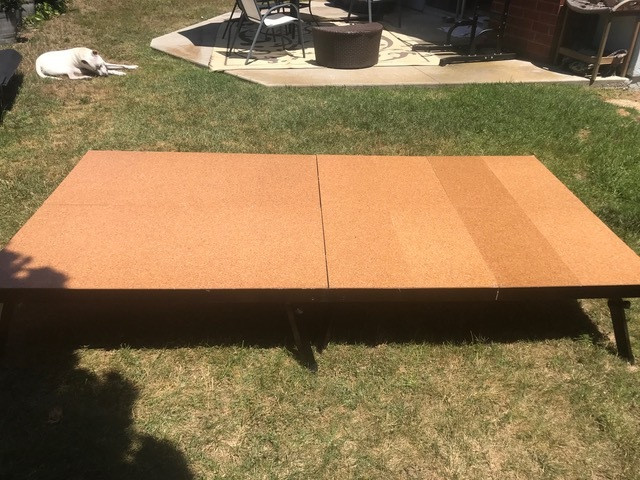
Each MyStage 4'x4' deck has five independently adjustable legs — four corners and a patented fifth center leg — that level the deck surface on any outdoor terrain without a single tool. The leveling procedure starts at the lowest corner of the stage footprint, works outward deck by deck, and takes 20 to 45 minutes for a complete multi-deck outdoor configuration. The five-leg system handles grass, gravel, packed earth, asphalt, and moderate slopes. Soft grass requires plywood pads under each leg foot. Mid-event recheck is required on all-day events on soft ground. |
The independently adjustable five-leg system is the technical reason MyStage levels on terrain that defeats fixed-height folding stages. A fixed-height stage places all legs at exactly the same length — which means every leg must touch the ground at exactly the same level for the platform to be stable. On any real outdoor surface, that never happens. A MyStage deck adjusts each of its five legs to the exact height that ground contact requires at that specific foot position, regardless of what the other four legs are doing.
This guide covers the complete leveling procedure for every outdoor surface type, the soft ground preparation that prevents mid-event sinking, the slope compensation technique for venues without a flat setup area, and the recheck protocol for all-day events where ground compression accumulates over hours.
Before You Place the First Deck: The 5-Minute Site Assessment
|
The most effective leveling investment happens before the first deck leaves the bag. A 5-minute walk of the full stage footprint with a level tool identifies the lowest corner, locates soft spots, confirms drainage direction, and marks the assembly sequence that will produce the most stable platform. Stage builders who skip this step discover the slope halfway through assembly, after three decks are connected, and spend 20 minutes correcting what a 5-minute assessment would have prevented. |
- Identify the lowest corner. Walk the footprint perimeter and note where the ground is lowest. This is where the first deck goes — the anchor deck that sets the reference level for the entire platform.
- Check for soft spots. Press a stake or tent rod into the soil at each leg foot position. Firm resistance = stable ground. Easy penetration = soft ground requiring plywood pads.
- Identify drainage direction. Water flows toward the low side of the footprint. Position the stage so the upstage edge is on the high side — surface water drains away from the platform rather than pooling underneath it.
- Mark the footprint corners. Use stakes, spray chalk, or orange cones to mark where each corner deck will go. A marked footprint prevents the assembly from drifting off-axis as decks are added.
- Carry plywood pads for soft ground. 12-inch square pieces of 3/4-inch plywood — one per leg foot per deck — are the insurance against mid-event sinking on any soft outdoor surface.
The Leveling Procedure: Anchor Deck First, Outward From There
|
The standard leveling procedure for a multi-deck outdoor platform follows one rule: the first deck sets the reference level, and every subsequent deck levels to match it. Place the first deck at the lowest corner of the footprint, extend all five legs to the height that produces a level surface at that position, confirm all five feet have firm ground contact, then connect adjacent decks and level them independently. Never connect an unlevel deck to a leveled one — the connected deck imports its unlevel into the joint. |
|
Step |
Action |
Time (per deck) |
Tool Required |
|---|---|---|---|
|
1 — Anchor deck |
Place at lowest footprint corner. Extend all 5 legs. Level in both axes. Confirm all 5 feet contact. |
4 to 6 minutes |
48-inch bubble level |
|
2 — Adjacent deck |
Connect to anchor. Level this deck independently. Check both axes and all 5 feet. |
3 to 5 minutes per deck |
Same level |
|
3 — Continue outward |
Add each deck from the anchor outward. Level before connecting the next. |
3 to 5 minutes per deck |
Same level |
|
4 — Full platform walk |
Walk every deck. Press each corner. No flex = correct. Any flex = re-adjust that leg. |
2 to 3 minutes total |
None |
|
5 — Load check |
Place all equipment and performers on stage. Walk perimeter again. Adjust any legs that moved. |
2 minutes |
None |
|
Expert Insight "The single biggest leveling mistake is connecting the second deck before the first is fully level. People are in a hurry and they connect three decks and then try to level the whole thing together. You cannot level a connected platform from one deck — each deck has to be level on its own before it joins. Get the anchor right first. Everything else is fast after that." — MyStage Corp |
Surface-Specific Leveling: Grass, Gravel, Concrete, and Slopes
|
Different outdoor surfaces require different preparation before the leveling procedure begins. Firm dry grass and gravel level without additional preparation. Soft or wet grass requires plywood pads under all leg feet. Concrete and asphalt are the most stable surfaces and level in the least time. Moderate slopes use the same five-leg adjustment with progressively different leg heights across the slope direction. Steep slopes require additional preparation or relocation to flatter terrain. |
Firm Dry Grass
- Standard leveling procedure — no additional preparation required.
- Rubber leg feet grip short dry grass without sinking or slipping.
- Recheck after full load, but mid-event recheck is usually not required on firm dry grass.
Soft or Wet Grass
- Place 12-inch square plywood pads (3/4-inch thickness) under each of the five leg feet before assembly. One pad per foot, five pads per deck.
- The plywood distributes the point load across a wider surface area — prevents leg penetration into soft soil under sustained performer and equipment load.
- After full assembly and load, recheck all leg feet for contact. Soft ground under load can settle slightly in the first 30 minutes — check again at the midpoint of any event longer than 3 hours.
Gravel and Packed Earth
- Firm gravel and packed earth are the most forgiving outdoor surfaces for stage leveling.
- No plywood pads required. Standard five-leg leveling procedure.
- Confirm each leg foot has contact with the ground surface rather than resting on a single gravel piece that could shift under dynamic performer load.
Concrete and Asphalt
- Most stable outdoor surface. Fastest leveling setup.
- No penetration risk, no drainage concern, no soft spot variation.
- Rubber leg feet grip without marking either surface. No floor protection required.
Sloped Terrain
- Place the anchor deck at the lowest corner of the slope — legs on the uphill side will be at minimum extension while legs on the downhill side extend to compensate for the slope drop.
- For gentle slopes (under 4 degrees), standard leg adjustment compensates without additional preparation.
- For slopes above 4 to 5 degrees, the downhill legs may approach their maximum extension range. Confirm the level is achievable before committing the full footprint to that position.
- Steep slopes (above 6 to 8 degrees) may exceed the leg extension range for some corner positions. Relocate to flatter ground or add subgrade leveling material (packed gravel, temporary modular flooring) to the low side before placing decks.
The Fifth Center Leg: Why It Matters for Outdoor Leveling
|
The fifth center leg on each MyStage deck is patented (US Patent 11,375,805) specifically because it solves the outdoor leveling problem that four-leg systems cannot. A four-leg platform on uneven ground contacts the ground at the three lowest legs — the fourth leg floats slightly, creating a rocking condition. The deck deflects at the center seam under load. The fifth center leg provides a fifth contact point that eliminates this rocking and prevents center-seam deflection regardless of how uneven the ground beneath the platform is. |
This is not an academic distinction on outdoor terrain. A four-leg platform on a grass slope that is perfectly level at the four corners may still rock under a performer's movement because the center of the deck has no support contact. The fifth leg eliminates this condition permanently. When the fifth center leg is extended to full ground contact on outdoor terrain, the deck is stable under any dynamic load pattern a performer or equipment places on it.
Mid-Event Recheck Protocol
|
A stage that was level at setup may drift slightly over the course of an all-day outdoor event as ground compression accumulates under sustained load, leg feet work into soft soil, or temperature changes affect the leg mechanisms. The mid-event recheck takes 5 minutes and prevents the gradual level drift that makes a stage feel unstable by the third act without anyone identifying the cause. |
- Short events (under 3 hours) on firm ground: initial load check only — no mid-event recheck required.
- All-day events (4 to 8 hours) on firm ground: one mid-event recheck at the midpoint — between acts 3 and 4 in a 6-act lineup.
- Any event on soft or wet ground: recheck after the first hour regardless of event length. Soft ground compresses most in the first 30 to 60 minutes under sustained load.
- After rain during an outdoor event: recheck all leg feet immediately if rain softens the ground beneath the platform. Rain that begins after setup can convert firm ground to soft ground — address immediately.
Full outdoor setup guidance by event type: outdoor festival stage for multi-act all-day events. outdoor concert stage for single-performance outdoor events. wedding stage for outdoor ceremony terrain. Load certifications at tech certifications. Contact MyStage at 858-229-8388 for configuration guidance.
Frequently Asked Questions
How do you level a portable stage on grass?
Start at the lowest corner of the footprint. Place the first deck there and level it fully on all five legs. Connect adjacent decks outward, leveling each independently before connecting the next. For soft grass, place 12-inch plywood pads under all five leg feet before assembly. Recheck all leg feet after full equipment and performer load is on the platform.
Can a portable stage be set up on a slope?
Yes. The five independently adjustable legs per deck compensate for moderate slopes by extending the downhill legs further than the uphill legs. For gentle slopes (under 4 to 5 degrees), standard leg adjustment handles leveling. For steeper slopes, the downhill legs may approach maximum extension — if they do, relocate to flatter ground or add subgrade leveling material to the low side.
What do you put under stage legs on soft ground?
12-inch square plywood pads at 3/4-inch thickness — one pad under each of the five leg feet per deck. The plywood distributes the leg's point load across a wider area, preventing penetration into soft soil under sustained performer and equipment weight. Carry five pads per deck for any outdoor event on questionable terrain.
How often should you recheck stage level during an event?
Short events (under 3 hours) on firm ground: initial load check only. All-day events (4 to 8 hours): one mid-event recheck at the midpoint. Any event on soft or wet ground: recheck after the first hour and again at the midpoint. After rain during an outdoor event: recheck immediately.
Do all five legs need to be adjusted?
Yes. All five legs must contact the ground firmly — including the patented fifth center leg (US Patent 11,375,805). The center leg supports the deck-panel seam and prevents deflection under load. A floating center leg creates bounce and flex even when all four corner legs are level. The fifth leg is not optional — it is the engineering feature that makes the platform stable on outdoor terrain.
What tool do I need to level a portable stage?
A 24-inch or 48-inch bubble level — the only tool required. Place it along the long and short axes of each deck surface to confirm level in both directions. MyStage leg adjustments are tool-free via push-button release. No power tools, no wrenches, no specialist equipment at any point in the setup or leveling process.