
By venue
Portable Stage for a Corporate Training, Offsite Workshop, or Leadership Retreat
|
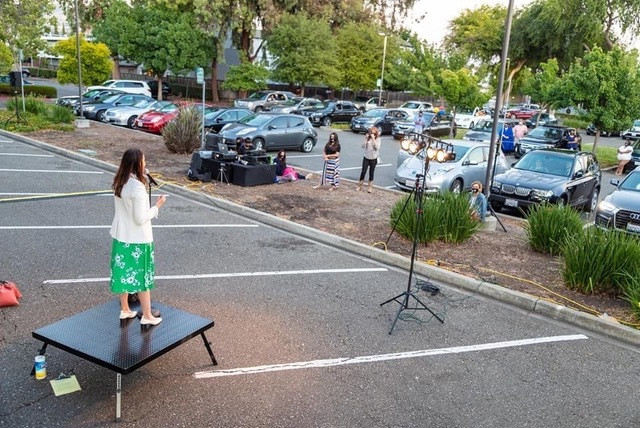
A corporate training facilitator platform is deliberately lower than a keynote presentation stage. Interactive workshop facilitation depends on the facilitator moving between the platform and the participant tables throughout the session — a 17-to-20-inch keynote height creates the separation that works against that movement. A 4'x8' platform (2 decks, $1,260) at 8 to 12 inches gives the facilitator demonstration visibility for the back rows while keeping them physically accessible to every table in the room. |
The corporate conference blog covers keynote presentations and formal panel sessions — one-directional communication where elevation reinforces authority. Training and workshop facilitation is bidirectional: the facilitator demonstrates from the platform, then walks into the room during exercises, stands beside a participant during a role-play, and returns to the platform to debrief. The height choice reflects this. Lower is better for facilitation.
Why Facilitator Platforms Are Lower Than Keynote Stages
|
A keynote speaker stays on the platform for the duration of their talk. A training facilitator steps on and off the platform 15 to 40 times across a full-day workshop — moving to flip charts, walking to breakout tables, standing beside participants during exercises, and returning to the platform for debriefs. Every inch of platform height adds friction to that movement. At 8 to 12 inches, the facilitator steps off and back on without breaking session flow. |
|
Session Type |
Communication Direction |
Facilitator Movement |
Recommended Height |
Access Method |
|---|---|---|---|---|
|
Keynote presentation |
One-directional to audience |
Stays on platform |
17 to 20 inches |
Step Up or Stairs |
|
Panel discussion |
One-directional, seated |
Stays on platform |
17 to 20 inches |
Stairs |
|
Interactive training workshop |
Bidirectional |
On/off 15 to 40 times |
8 to 12 inches |
Direct step — no stairs |
|
Leadership retreat facilitation |
Bidirectional, high interaction |
On/off frequently |
8 to 12 inches |
Direct step — no stairs |
|
Skills demonstration training |
Bidirectional with demos |
On/off moderate |
10 to 12 inches |
Direct step — no stairs |
|
Executive coaching group session |
Highly bidirectional |
Mostly off platform |
8 to 10 inches |
Direct step — no stairs |
Platform Sizing for Training Groups
|
A training facilitator platform needs enough surface area for the facilitator to move between three functional positions without stepping off: the flip chart or whiteboard position, the center demonstration position, and the reference position beside a projected screen. A 4'x8' platform provides all three. A 4'x4' platform is too small — the facilitator is confined to a single standing position, which defeats the purpose of having a platform at all for an interactive session. |
|
Training Group Size |
Room Type |
Platform Size |
Deck Count |
Cost |
|---|---|---|---|---|
|
12 to 25 participants |
Conference room or small breakout |
4'x8' |
2 decks |
$1,260 |
|
25 to 60 participants |
Hotel breakout or training room |
4'x8' |
2 decks |
$1,260 |
|
60 to 120 participants |
Hotel ballroom section |
8'x8' |
4 decks |
$2,480 |
|
120 to 200 participants |
Full ballroom or auditorium |
8'x8' to 8'x12' |
4 to 6 decks |
$2,480–$3,720 |
|
Executive retreat (8 to 20 people) |
Retreat center or boardroom |
4'x4' to 4'x8' |
1 to 2 decks |
$659–$1,260 |
For groups above 120 participants in a full ballroom setting, the session format typically shifts from interactive facilitation toward presentation delivery — at that point the keynote configuration (17 to 20 inches with stairs) becomes the appropriate choice rather than the low facilitator platform.
Hotel Breakout Room and Client Site Setup
|
Corporate training happens in rooms the facilitator does not control: hotel breakout rooms with fixed AV, client conference rooms with existing furniture layouts, and retreat centers with variable floor plans. A 4'x8' facilitator platform occupies 32 square feet at the front of any of these rooms without requiring furniture removal, AV coordination, or facilities staff involvement. Setup takes 6 minutes. The platform sits in front of the existing screen or projection surface without blocking it. |
- Hotel breakout room: position at the front of the room, centered on the projection screen, 3 to 4 feet forward of the screen so the facilitator does not cast a shadow on projected content.
- Client conference room: position at the head of the table arrangement or at the front of a classroom-style layout. Confirm the platform does not block existing wall-mounted displays or whiteboards.
- Retreat center: position where the natural room focus is — typically opposite the entrance with participants distributed in front. Retreat rooms often have irregular shapes; place the platform at the widest sightline point.
- Outdoor offsite session: patio or lawn setting at a retreat center. Use plywood pads under leg feet on grass. The independently adjustable legs handle outdoor terrain that indoor-only platforms cannot.
The Traveling Consultant Setup
|
An independent training consultant delivering 40 to 80 sessions per year at client sites needs a platform that travels as reliably as their materials. Two decks in two gear bags at 42 lbs each transport in any car trunk, check as oversized luggage on domestic flights, or ship ahead via freight for multi-day engagements. The consultant arrives at any client site with the certainty that the facilitator platform will be exactly what they expect — regardless of what the client venue provides. |
|
Expert Insight "Every consultant who travels to client sites has the same story: you show up and the room is different than what was described. Sometimes there is a riser, sometimes there is nothing, sometimes there is a permanent stage that is far too high for an interactive session. Carrying your own platform removes that variable completely. You know exactly what you are working with before you walk in the door." — MyStage Corp |
What the Platform Actually Improves
|
A facilitator platform improves training session quality in three measurable ways. Back-row participants in a 40-person training room can see demonstrations and body language rather than only hearing audio. The defined elevated position gives the facilitator a home base that structures the session rhythm between instruction and interaction. And flip chart or whiteboard work performed from the platform is visible to the full room rather than only the front two tables. |
- Demonstration visibility: skills training that involves physical demonstration — presentation skills, difficult conversation role-play, body language coaching — requires participants to see the facilitator's full body. Without elevation, only the front three rows can.
- Session rhythm and structure: the platform is a visual signal. Facilitator on the platform means instruction mode. Facilitator in the room means interaction mode. Participants read this transition automatically, which reduces the verbal signaling required to shift between session modes.
- Flip chart visibility: a flip chart at floor level is legible to the front two tables. The same flip chart on a 10-inch platform is legible to the back of a 40-person room.
- Professional signal: for independent consultants, arriving with a proper facilitator platform signals a level of preparation and investment that clients notice, particularly in competitive consulting engagements.
Browse platform configurations and Shorties leg options at portable stages and shop all stages. For larger corporate event formats requiring keynote height, see event stage. Load certifications at tech certifications. Contact MyStage at 858-229-8388 for L&D team and consultant pricing.
Frequently Asked Questions
What size platform does a corporate training facilitator need?
12 to 60 participants: 4'x8' (2 decks, $1,260). 60 to 120 participants: 8'x8' (4 decks, $2,480). Executive retreat of 8 to 20 people: 4'x4' to 4'x8' (1 to 2 decks). The 4'x8' provides room for the facilitator to move between flip chart, demonstration, and screen reference positions without stepping off.
What height should a training facilitator platform be?
8 to 12 inches — deliberately lower than a keynote stage. Interactive facilitation requires the facilitator to step on and off 15 to 40 times per session, moving between the platform and participant tables. Lower height removes friction from that movement and keeps the facilitator physically accessible.
Why is a training platform lower than a keynote stage?
A keynote is one-directional — the speaker stays on the platform and elevation reinforces authority. Training is bidirectional — the facilitator moves constantly between the platform and the room. A 17-to-20-inch keynote height creates separation that works against interactive facilitation. 8 to 12 inches provides visibility without separation.
Can a facilitator platform be set up in a hotel breakout room?
Yes. A 4'x8' platform occupies 32 square feet at the front of any standard breakout room. Sets up in 6 minutes without tools, without AV coordination, and without facilities staff. Rubber leg feet grip hotel carpet and hard flooring without marking.
How does a traveling consultant transport a platform?
2 decks in 2 gear bags at 42 lbs each — car trunk, checked luggage on domestic flights, or shipped ahead via freight. An independent consultant delivering 40 to 80 sessions per year carries the platform in the same load as materials and flip chart supplies.
How much does a corporate training platform cost?
4'x8' (2 decks) + 2 gear bags: $1,436 complete. 8'x8' (4 decks) + 4 gear bags: $2,832. For an L&D team running 30 to 60 sessions per year, the platform amortizes to $24 to $48 per session in year one and near zero thereafter.